
Section 30.3 Least Squares (Linear Regression)
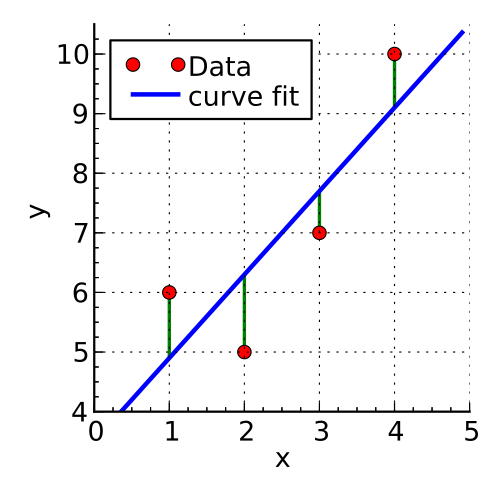
Suppose we have \(N\) data points \((x_i, y_i)\) and want to find the straight line \(y = mx + b\) that fits them as closely as possible. The least squares method finds the slope \(m\) and intercept \(b\) that minimize the sum of the squared vertical distances (shown below in green) between the data points and the line, using these formulas:
\(\displaystyle m = \frac{N \sum(x_iy_i) - \sum(x_i) \sum(y_i)}{N \sum(x_i^2) - \left(\sum(x_i)\right)^2}\)
\(\displaystyle b = \frac{\sum(y_i) - m\sum(x_i)}{N}\)
The example below plots a set of data points along with their least-squares line of best fit.